
Preparedness That Saves Lives: Why Critical Infrastructure Workers Must Be Ready for Emergencies
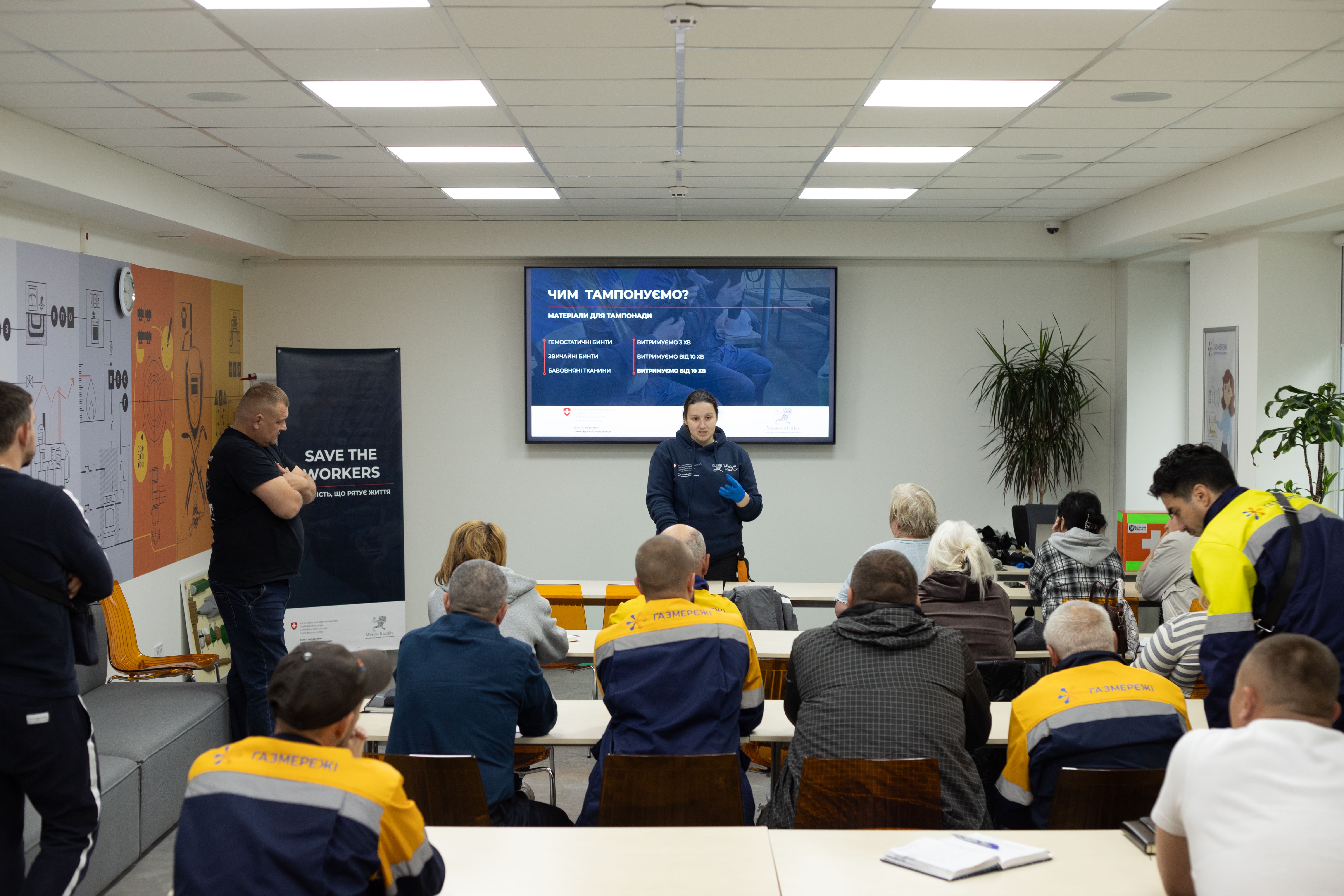
The resilience of critical infrastructure depends not only on equipment, technical capacity, and the speed at which damaged systems can be restored. It also depends on the people who keep these systems running every day and who may find themselves having to act in the face of shelling, accidents, and other emergencies.
During the full-scale war, workers in the energy, gas, heating, water supply, and other critical infrastructure sectors have been operating under heightened risks. They provide electricity, gas, heat, and water to millions of people, often restoring systems after attacks and damage.
At the same time, these workers may be among those who need to be the first to assess a situation, ensure their own safety, and provide first aid to injured colleagues before emergency services arrive.
That is why emergency preparedness among personnel must not be treated as an optional extra, but as an integral part of Ukraine’s critical infrastructure safety and resilience system.
More than 13,000 Workers Trained: Three and a Half Years of Experience
Over three and a half years of implementing the Save the Workers project, Mission Kharkiv has been systematically working to prepare critical infrastructure personnel to respond to emergencies.
During this period, approximately 700 training sessions have been conducted, with 13,956 employees from companies providing essential services to the population completing the training. Participants included employees of gas supply companies, energy, heating, and water supply facilities, as well as other critical infrastructure sectors whose work is directly linked to providing essential household services.
The training covered practical first aid skills, including responding to life-threatening bleeding and using first aid equipment. In addition to the training sessions, companies received first aid kits and relevant equipment to help them respond to emergencies.
Over this period, we have seen that even with limited time available to employees, it is possible to develop accessible training formats that deliver essential knowledge and allow participants to practise practical skills.
One such solution was adapting the duration of training sessions to two hours, focusing on the most critical skills. This makes it possible to involve company employees without placing an excessive burden on their core operational activities.
At the same time, our experience shows that one-off training, even when high-quality and practical, cannot ensure long-term preparedness. Skills need to be practised repeatedly, and response systems need to be continuously improved.
From One-Off Training Sessions to an In-House Training System
One of the main challenges we have identified is the reliance on external initiatives, projects, or donor support to provide training.
When a company takes part in project-based training, its employees gain essential knowledge and an opportunity to practise. However, over time, some staff members leave, new employees need training, and previously acquired skills gradually deteriorate without regular practice.
The next step, therefore, should be a shift from a model in which external organisations train individual groups of employees to one in which companies themselves have the capacity to deliver such training regularly.
We see significant potential in developing a Train the Trainers approach, which involves preparing in-house instructors directly within critical infrastructure companies.
This means selecting employees who will receive advanced training, master the methodology for delivering practical sessions, and then be able to train their colleagues. This would allow companies to move away from relying on the occasional availability of external training teams and establish an ongoing process of staff preparedness.
A further step could be the creation of in-house training units or training centres within large critical infrastructure companies. These facilities should be equipped with training materials, mannequins, practice equipment, first aid kits, and other tools needed to develop practical skills.
It is important that in-house instructors do more than simply pass on information. They should follow a standardised curriculum, receive regular professional development, and be able to update training materials in line with current recommendations.
This approach is consistent with international recommendations on basic life support. In particular, ANZCOR emphasises the need for appropriate instructor training, regular skills updates, and practical assessment of participants’ competencies.
A First Aid Kit at the Workplace Is Part of Occupational Safety, Not a One-Off Donation
Another important lesson from our experience concerns the provision of first aid equipment to workers.
Providing companies with first aid kits through humanitarian projects helps address urgent needs. However, long-term preparedness cannot depend solely on donor-funded supplies.
The availability of first aid kits, personal protective equipment, and other essential supplies must be an ongoing responsibility of the employer and an integral part of the occupational safety system. This involves not only the initial provision of equipment, but also regular checks of its contents, monitoring expiry dates, timely replenishment of used supplies, and ensuring that equipment is accessible directly where work is carried out.
This is particularly relevant for emergency response teams working in the field, at remote facilities, or in high-risk conditions. In such cases, first aid equipment must be available not only in company administrative buildings, but also in vehicles and at worksites, according to assessed risks.
It is also important that first aid kit contents reflect the nature of a company’s activities and the potential risks involved. For example, the needs of workers at energy facilities, emergency gas services, and water utilities may differ.
International practice supports this approach. OSHA emphasises that workplace first aid programmes should take into account the specific risks associated with a facility, and that staffing and equipment must be appropriate to those risks.
A first aid kit, therefore, should not simply be a piece of equipment handed over to a company. It should form part of an ongoing safety system for which the company itself is responsible.
From Bleeding Control to Comprehensive Preparedness: Skills Need Regular Updating
Initial training focuses on the most critical actions that can save lives before medical professionals arrive. However, workers’ emergency preparedness should cover a broader range of skills.
In addition to controlling life-threatening bleeding, training programmes should gradually expand to include Basic Life Support (BLS). This should cover:
- assessing scene safety and the condition of the injured person;
- recognising signs of life-threatening conditions;
- correctly calling emergency services;
- opening and maintaining the airway;
- cardiopulmonary resuscitation (CPR);
- using an automated external defibrillator (AED), where available;
- practical response to other medical emergencies, according to the risks specific to each company.
It is important that training is not limited to theoretical explanations. Employees should regularly practise their skills using mannequins, training equipment, and scenarios that reflect the actual conditions in which they work.
Refresher training also deserves particular attention. We believe it is advisable to introduce comprehensive practical refresher sessions at least once every six months for employees of companies operating in higher-risk environments, supplemented by short practical exercises between the main sessions.
This does not mean that a full course needs to be repeated from scratch every time. Short practice sessions focused on individual skills, team simulations, and equipment readiness checks can all become part of a company's regular operations.
ANZCOR and the European Resuscitation Council (ERC) recommendations also emphasise the importance of spaced learning, repeated practice, and the assessment of practical skills rather than the acquisition of theoretical knowledge alone.
The Ukrainian Context Requires a Higher Level of Preparedness
It is important to recognise that preparing critical infrastructure workers in Ukraine must take into account circumstances that go far beyond standard occupational risks.
Workers may find themselves at facilities following missile or drone attacks, carrying out prolonged emergency restoration work, facing limited access to emergency services, or having to act under the threat of further attacks.
Training programmes must therefore address not only the medical aspects of emergency response, but also the safety of the responder, coordination within teams, communication, evacuation, and procedures to follow if the threat re-emerges.
No first aid skills should encourage employees to expose themselves to additional danger. Personal safety must remain the priority, alongside responding appropriately to the situation and coordinating with professional emergency services.
That is why international approaches should not simply be copied, but adapted to the realities of Ukraine, the specific characteristics of each sector, and the conditions in which companies operate during the war.
Preparedness That Saves Lives Must Become an Ongoing System
Over three and a half years of work, we have trained 13,956 critical infrastructure workers and conducted more than 600 training sessions. For us, this is not only a quantitative result, but also an opportunity to identify solutions that can make preparedness more effective and sustainable.
We believe the next stage should involve moving from individual training initiatives towards a comprehensive safety system at the company level.
This system should include:
- trained in-house instructors and training facilities within companies;
- regular refresher training in practical skills and expanded first aid programmes;
- the continuous provision of essential personal protective equipment and first aid supplies to employees;
- integration of training and equipment provision into occupational safety systems and internal company procedures;
- adaptation of training programmes to the specific risks of each critical infrastructure sector.
We cannot eliminate all the risks associated with the war, and training cannot guarantee that no lives will be lost. However, we can create conditions in which workers have more knowledge, practical skills, and the necessary equipment to respond.
The resilience of critical infrastructure is not only about restoring electricity, heating, or water supply after damage. It is also about protecting the people who keep these systems functioning every day.
Preparedness that saves lives is not a one-off training session. It is a safety culture that needs to be developed at every company.
This article was prepared by Iryna Udod, Programme Manager at Mission Kharkiv.
Related Articles




Stay connected with us
Whether you’re interested in becoming a partner, have a question or need support, we’re here for you. Fill out the form below to get in touch
